CONTACT US
 NEWSLETTER SIGN UP
10. Old library
This recently renovated house was used as council offices by Kirkheaton Urban District 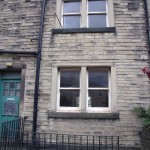 Council until 1938 and later by Kirkburton UDC. It was also in use as the village library until it was moved to the Community Centre.
Continue up to Town Top
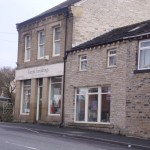 11. Green’s Furnishings
This modern shop is housed in one of the two co-operative shops in the village. On the gable end can be seen the large doors on the second floor and crane. This was for the lifting of large sacks of sugar, flour, potatoes etc into the storeroom.
Cross the road and walk up Moorside Road to the Scout Hut
12. Site of workhouse
According to earlier maps [until at least 1930’s] Moorside Road used to be called Workhouse Lane. Until 1871 Kirkheaton Workhouse stood near to the present Scout Hut. Despite local beliefs there is no evidence to substantiate the existence of pauper graves in this area. On the contrary, the workhouse needed ground to grow their own food. There are records of inmates being buried at St John’s churchyard and elsewhere.
During the nineteenth century workhouses were built following an
Act of Parliament in 1834, to house poor people. An extract from the Huddersfield Chronicle in 1866 records a visit by the Poor Law Inspectors to Kirkheaton Workhouse. At that time there were 47 inmates.16 boys and 2 men shared 8 beds in two small rooms. 6 women, 21 girls and 2 infants shared 13 beds. Conditions were appalling.’Three of the boys are in habit of “wetting the bed,” they are placed to sleep in the same bed; it was in an abominable condition; the urine had not only saturated the bedding, and the boards beneath the bed, but had found its way through the floor into the room below.’ The report went on ‘The copper in which the foul linen is boiled is used also for cooking the food of the inmates.’
No sign of this unhappy place is now evident.
Retrace your steps down Moorside Road until Fields Rise. Turn right here and walk along to the Community Centre
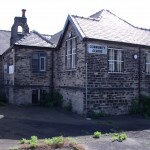 13. Present library
This is situated in the old infant school which opened in 1883. It was obviously very much needed. As early as 1869 an HMI had complained that ‘the infants… [at that time located in the school building near the church] are in a very unsatisfactory state. They are crowded into a small room where it is impossible for them to move from their seats to exercise. They know very little. There is not even an alphabet card for them.’ But even then the accommodation was never really adequate. When school dinners began in the 1940’s the children had to go off the premises to eat them in the Fields Chapel Schoolroom – now Happy Days Nursery.
The school closed in 1982 and the children were transferred to the County First School on New Road. The building was used as an annexe for the combined schools for about a year.
Later it was to become the Community Centre, voting hall and library.
Recross the road and turn right onto New Road
14. Kirkheaton United Church
This was originally the Congregation Chapel which became the United Church of 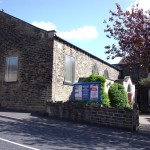 Kirkheaton when Upper Heaton Chapel closed in 1975. The datestone on the Church schoolroom [now part of Happy Days Nursery ] tell us it was built in 1833 and extended in 1835.
Cross and look at the row of houses at right angles to New Road
15. Fields Terrace and Fields Place
Turn back down New Road to its junction with Bankfield Lane
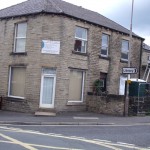 16. Corner plot
The building at the corner of Bankfield Lane and New Road has had many reincarnations. In the recent past it has been a funeral home, hardware shop and now as part of a domestic property. It is said that it once was the village post office in the 19th century but there is no evidence for this assertion. However Kirkheaton Post Office was also located on Laneside before moving to St Mary’s Lane [in 1921] where it remained until its closure in Autumn 2018. [Postal services are now available at Costcutter on the corner of Town Road and Moorside Road].
Turn right onto Bankfield Lane
17.Site of smithy
One of the two known village smithies was sited on the premises now occupied by Kirkheaton Engineering.
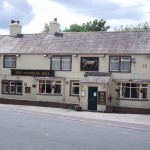 18. Spangled Bull
The date stone is 1740 makes this building one of the oldest in the village.
19. Select & Save at Field Head
For many years this building was occupied by Field Head Co-op or Kirkheaton Industrial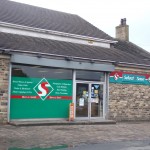 Society. This society existed before Rochdale Co-operative Society which claimed to be the first. It was founded in 1834 when 10 local people pooled their money to become the first shareholders. Until recently each member of a society had a personal ‘coop number’ which entitled them to receive a share of the profits [divi] based on how much they had spent in the shop. The society also owned 17 acres of land for the benefit of the members.
The modern frontage obscures an 18th century building. Notice the blocked up venetian window on the gable end.
Turn down Stead Lane and continue on the rough track to Hillside
20 Hillside House
This is the site of the first electricity generating station in the village which was built by a member of the Broadbent family around 1900. This eventually supplied 160 private consumers and street lighting. The building of 24 houses by the council after World War 1 meant that demand outstripped supply and the York Electric Power Company took over the generating of the supply in 1923.
Turn right down St Mary’s Lane to the industrial estate after the entrance to Newland Road
21 Site of railway station
The land now occupied by various industrial units was once Kirkheaton Railway 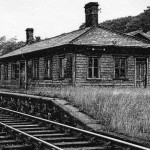 station. The line was built in 1867 from Huddersfield to Kirkburton via Deighton, Kirkheaton and Fenay Bridge. Eventually it was intended to run all the way to Barnsley but this never materialised. The building of the line was a feat in itself and not without its problems- the first two arches of the seven arched viaduct over the Colne collapsed into the canal in February 1866.
  But at 7am on New Years Day 1868 the first train on the line set out from Huddersfield station. It proved very popular and even in the 20’s despite competition from local steam trams, 12 trains ran every weekday with extra on Saturdays. Its demise as a passenger line came in 1931 when the train company amalgamated with Huddersfield Corporation to form the Joint Omnibus Committee. Their fleet of buses killed off the passenger service and the last train ran on Saturday 26 July 1931. Freight trains still continued to the private sidings at British Dyes [later ICI], Elliots Brickworks and several local coal mines. But by 1965 the majority of the line closed.